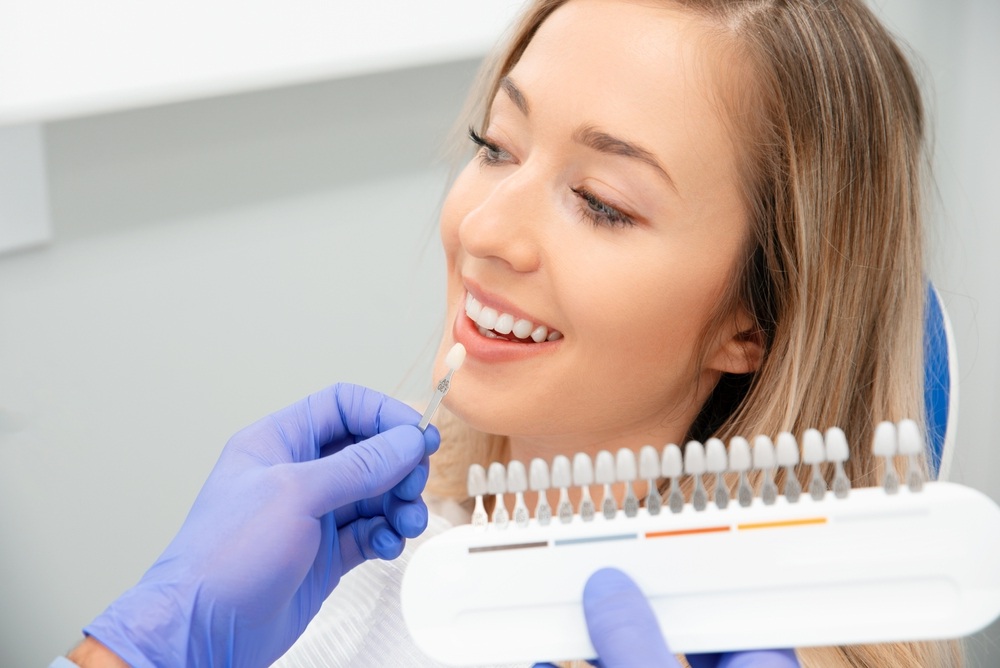
Dental veneers are thin, custom-fabricated shells bonded to the front surface of teeth to improve color, shape, size, or length. According to The Journal of the American Dental Association, a veneer is “a thin covering that is placed over the front (visible) part of the tooth.”
How they’re made has shifted considerably over the past several decades, moving from hand-crafted porcelain veneers produced at off-site dental labs to digitally designed and in-office 3D-printed options. The Wikipedia article on veneer dentistry traces the history, “Veneers were invented by California dentist Charles Pincus in 1928 to be used for a film shoot for temporarily changing the appearance of actors’ teeth. Later, in 1937 he fabricated acrylic veneers to be retained by denture adhesive, which were only cemented temporarily because there was very little adhesion.”
Permanent bonding only became possible through later research. “The introduction of etching in 1959 by Dr. Michael Buonocore aimed to follow a line of investigation of bonding porcelain veneers to etched enamel. Research in 1982 by Simonsen and Calamia revealed that porcelain could be etched with hydrofluoric acid, and bond strengths could be achieved between composite resins and porcelain that were predicted to be able to hold porcelain veneers on to the surface of a tooth permanently.” For patients in San Marcos, Rancho Bernardo and the surrounding North County San Diego area weighing cosmetic dental options, knowing how 3D printed veneers differ from conventional fabrication methods, what conditions they address, and what the treatment process looks like helps set realistic expectations before a clinical evaluation.