Meet the Doctor
Dr. Khizer Hafeez is a Doctor of Dental Surgery, having earned his degree from the prestigious New York University College of Dentistry. Licensed by the Dental Board of California, Dr. Hafeez brings advanced expertise across a broad range of disciplines, including dental implantology, restorative dentistry, cosmetic dentistry, and general dentistry. He is dedicated to combining clinical precision with a personalized, patient-first approach to help each individual achieve a healthy, confident smile.
Dental Implants
Losing a tooth sets off a chain of events in the jaw and surrounding teeth that most patients don’t realize is happening until it’s been going on for a while. The sections below cover the clinical picture, what a typical implant case involves from start to finish, and why acting sooner tends to be significantly better than waiting.
Are you a candidate for dental implants?
A lot of patients who come in for an implant consultation have been living with a missing tooth longer than they expected. Life gets busy, the gap feels manageable, and the decision keeps getting deferred. What most people don’t realize is that the window for straightforward implant placement quietly narrows with every passing month, because the jawbone beneath an empty socket starts changing immediately after the tooth is gone.
Who is a candidate for dental implants?
Adults missing one tooth or several are typically worth evaluating, and many patients who assume they don’t qualify actually do. What matters clinically is bone volume at the intended implant site, gum tissue health, and whether any underlying conditions that affect healing can be managed before treatment begins. Patients who’ve experienced significant bone loss may need a grafting procedure first, but that doesn’t disqualify them. A proper dental exam and imaging tell us exactly what we’re working with.
What does the dental implants process involve?
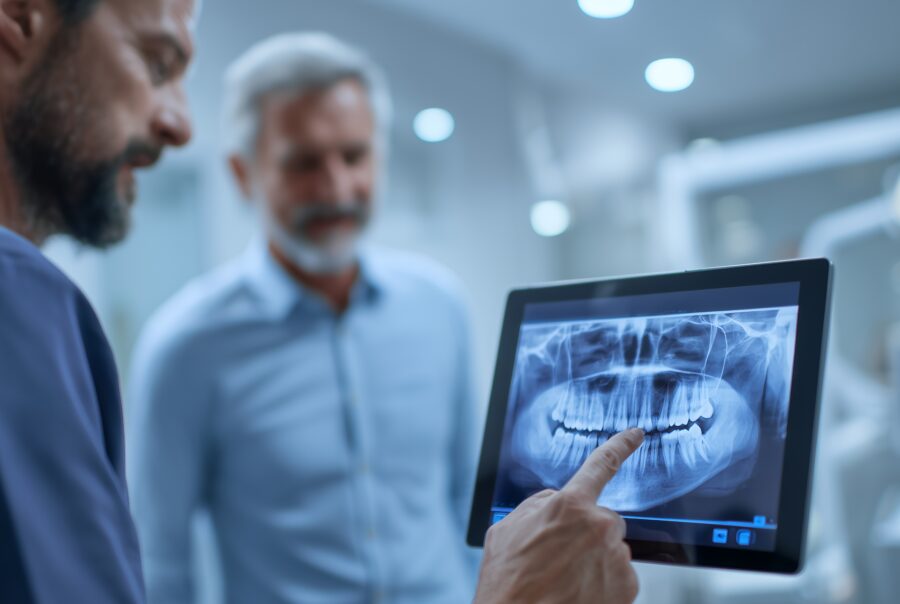
Before any treatment decision is made, we image the jaw using the Dexis OP 3D cone beam system. This produces a three-dimensional map of bone depth, nerve locations, and sinus anatomy that conventional dental X-rays can’t capture. The Trios 6 digital scanner replaces putty impressions entirely. From there, we determine which implant restorative approach fits: a single implant crown, an implant bridge, implant-supported dentures, a 3 on 6 restoration, or an All-on-X procedure. Patients who qualify may also be candidates for immediate implant placement, where the post goes in the same day a tooth is removed.
Where does dental implants fit into your treatment plan?
Every phase of treatment is handled within this dental practice, from the initial cone beam scan through placing the final crown. Some cases move through in a matter of months; others take longer depending on whether preparatory procedures like bone grafting are needed first. For patients addressing multiple dental concerns at once, each phase is sequenced deliberately so nothing is done out of order and no step has to be repeated because something earlier was missed.
When is the right time to consider dental implants?
The straightforward answer is as soon as possible after tooth loss. Bone loss after extraction doesn’t happen dramatically, but it compounds. A jaw that supports an implant easily at six months may need a graft at eighteen. Patients who’ve worn dentures for years still deserve an evaluation because many still qualify, though the path may be more involved. The gap between a straightforward implant case and one that now requires additional surgery is often smaller than patients expect.
Why choose dental implants over the alternatives?
dental bridges anchor to the adjacent teeth, which means those teeth get permanently altered to hold the restoration. dental crowns and bridges used as traditional replacements do nothing to stop the bone from shrinking in the gap beneath them. Implants replace the root itself, which is what keeps the jawbone stable and stops neighboring teeth from drifting. On survival data alone, the difference is clear: a retrospective study published in PMC followed 687 implant-supported prostheses and documented that “the 5-year survival rate was 99.0% and the 10-year cumulative survival rate was 98.1%.” No bridge or denture comes close to those numbers over the same horizon.
Delaying Tooth Replacement Puts Your Jawbone, Remaining Teeth, and Long-Term Oral Health at Risk
Bone loss after tooth extraction follows a predictable pattern starts quietly, then accelerates. ClinicalTrials.gov explains that without intervention, more than half the bone in the extraction area can be gone within the first year. As the bone shrinks, adjacent teeth tilt toward the gap, the bite shifts, and what could have been a single implant becomes a case that requires more preparation, more procedures, and more time to restore your dental health. The cost of delay isn’t always just financial.
Cosmetic Dentistry
Cosmetic concerns don’t always feel urgent, which is exactly why patients carry them for years without acting. The sections below cover what cosmetic dental treatments can realistically address, how to know whether you’re a candidate, and why deferring often means dealing with more than you would have had to originally.
What can cosmetic dentistry actually change?
Most people who ask about cosmetic dentistry have something specific in mind, not a complete overhaul. A front tooth that’s shorter than its neighbor. Discoloration that whitening strips can’t touch. A chip that photographs badly. A dentist who focuses on cosmetic dental work can give you an honest read on what’s fixable, what the process actually involves, and what the result will look like before anything is placed in your mouth.
Who Is a Candidate for Cosmetic Dentistry?
Candidacy for cosmetic work depends on the health of the underlying teeth, not just how they look. Patients with chips, surface staining, worn or uneven edges, or teeth that appear shorter than they should are often good candidates for prepless veneers or a full smile makeover. For patients with spacing concerns, clear aligners may be worth discussing before or alongside cosmetic work. Those with active decay or unstable gum tissue need to resolve those conditions first. A comprehensive dentistry approach means we look at the full picture during your smile consultation so nothing gets missed.
What does the cosmetic dentistry process involve?
The process starts with a smile consultation and a digital scan using the Trios 6. We design the veneer shape on screen so you can evaluate the result before fabrication begins. From there, our SprintRay system produces veneers in-office rather than sending them to an outside lab. Prepless veneers require little to no enamel removal, which means the underlying tooth structure stays intact throughout. For patients pursuing a full smile makeover, the scope is mapped out during consultation and each visit has a defined purpose.
Where does cosmetic dentistry fit into your treatment plan?
Cosmetic work goes on last. If there are restorative dental services needed, decay to address, or gum disease to treat, those come first. Veneers placed on a compromised foundation don’t hold up the way they should. Once the underlying situation is stable, the cosmetic plan can move forward with confidence. Because fabrication happens in-house, the turnaround between visits is tighter than it would be at a practice dependent on external labs.
When is the right time to consider cosmetic dentistry?
There’s no clinical line that has to be crossed before a cosmetic consultation makes sense. If a concern has been bothering you for more than a few months, that’s enough reason to at least find out what the options are. What tends to happen when patients wait is that a chip progresses to a fracture, surface staining deepens into enamel, or something that was a veneer candidate becomes a crown candidate instead. Cosmetic concerns have a way of becoming structural ones.
Why choose cosmetic dentistry over the alternatives?
Dental bonding is cheaper upfront but more prone to staining and chipping, and it gets replaced more frequently. Traditional veneers involve permanent removal of tooth enamel that can’t be restored afterward. Prepless veneers address the concern without committing the tooth to permanent structural change, and the durability data backs this up: a PMC study that followed both veneer types over a mean of nine years found that “over a mean observation period of 9 years, the survival rate of no-prep/minimally invasive veneers exceed that of conventional veneers,” with the no-prep group achieving a 100% success rate throughout the study period.
Untreated Cosmetic Concerns Can Progress Into Structural Problems That Require More Invasive and Costly Intervention
A chipped tooth isn’t just a cosmetic issue. The fractured edge creates a new weak point, and normal bite pressure can extend that crack over time. Enamel thinning from erosion keeps thinning; once the enamel is gone it doesn’t come back. Research published in PMC explains, “progressive erosive loss may lead to functional and aesthetic limitations, as well as hypersensitivity, and extensive restorative treatment often becomes necessary.” What could have been a veneer becomes a crown. What could have been corrected easily turns into a procedure that takes more time, more visits, and more cost.
Emergency Dentistry
When something goes wrong with a tooth, most people’s first instinct is to manage the pain and wait to see if it settles. Dental problems rarely settle on their own. The sections below cover how to recognize when a dental situation can’t wait, what to expect when you call, and what the research shows about the difference between acting quickly and putting it off.
How do you know when a dental problem can’t wait?
Pain that builds instead of fades. Swelling that’s spreading toward the jaw or cheek. A tooth that’s cracked, knocked loose, or been knocked out entirely. A crown that came off and left the tooth underneath exposed. These aren’t symptoms to monitor over a few days. A dentist who treats emergencies the same day can make the difference between saving a tooth and losing it entirely.
Who is a candidate for emergency dentistry?
Emergency care applies to any patient with symptoms that are escalating rather than resolving. This includes severe or worsening toothaches, dental abscesses, cracked or fractured teeth, avulsed teeth, and lost fillings or crowns that expose tooth structure. Patients who need a root canal to preserve a tooth and those who need an extraction because the tooth can’t be saved are both within scope here. We don’t triage patients toward outside referrals for the procedures that matter most.
What does the emergency dentistry process involve?
When you call with an emergency, the goal is to get you in that day. The visit starts with imaging, including cone beam CT when the clinical picture calls for it, so we understand exactly what we’re treating before treatment begins. Root canal therapy, extractions, and same-day dental crowns are all handled in-office. If a tooth needs to come out and the patient wants to think about replacement options, that conversation happens before they leave. Our SprintRay technology means a finished crown is available the same day, even following emergency treatment.
Where does emergency dentistry fit into your treatment plan?
The emergency visit addresses the immediate problem first. What follows depends on the tooth and what was done. A root canal will need a crown over it. An extracted tooth may be a candidate for an implant later. Because North County Aesthetics and Implants handles restorative dental services, cosmetic work, and implant care, any follow-up treatment continues in the same dental office. You don’t have to start over with a new provider, resubmit records, or re-explain your history to someone new.
When is the right time to seek emergency dentistry?
Immediately. Pain that has lasted more than a day without improving, visible swelling around a tooth or along the gumline, a tooth that’s suddenly mobile, fever associated with dental pain, or any sign that an infection is spreading are all reasons to call the same day rather than wait for a scheduled slot to open. Dental infections don’t follow a polite timeline. They develop quickly, and the point at which a tooth can still be saved passes faster than patients anticipate.
Why seek emergency dentistry instead of managing pain at home?
Over-the-counter analgesics can reduce the sensation of pain for a few hours. They do nothing to address the infection, structural damage, or pulpal involvement that’s driving it. An abscess does not clear up on its own. A cracked tooth does not stabilize without treatment. A PMC study on odontogenic infections found that “prompt transfer of patients presenting with orofacial infections with suspected sepsis to the acute hospital setting for early treatment will improve survival rates.” Calling when the problem starts is almost always a significantly better outcome than managing it at home until it can’t be ignored.
A Dental Emergency Left Untreated Can Escalate From Localized Pain Into Systemic Infection and Permanent Tooth Loss
A dental abscess that goes untreated does not stay localized. The surrounding bone, the tissue of the jaw, the lymph nodes, and the structures of the neck are all downstream from an infected tooth. NIH StatPearls explains, “left untreated these infections can be not only extremely painful but also pose a significant risk of descending into the deep neck space or ascending to intracranial sinuses.” What started as a dental problem becomes a reason for hospitalization. Cracked teeth follow the same progression, a fracture that was treatable becomes a tooth that can only be extracted. The cost of acting early, in time, money, and discomfort, is almost always less than the cost of waiting.
Your dentist in Escondido Serving North County
The range of services offered at our dentist in Escondido is broader than a typical dental office. If you’re looking for a dental practice that handles implants, cosmetic dental treatments, and emergencies without sending you to a different provider for the part that matters, North County Aesthetics & Implants is the place to start. Call our office at 760.599.6559 to book a consultation today! If you live closer to San Diego, call our Rancho Bernardo office at 858.451.0550.